

When History Curves Backward: Rewatching 'Race Ipsa' in 2025
To explore further, check out our recent Attorneys with Swag podcast episode “LatinoJustice” to learn how the past continues to repeat itself.
The Past Is Prologue
It’s past midnight in the Bronx, and I’m nursing a half-cold coffee (Irish whiskey didn’t feel right for this). The TV casts a faint blue glow on my wall as I cue up an old episode of Boston Legal—Season 2, Episode 23, “Race Ipsa.” I expected a nostalgic laugh, maybe some retro early-2000s camp. Instead, I got a punch in the gut. Here was a primetime courtroom dramedy from 2006 tackling racial profiling and civil rights violations with a sharpness that made me forget the nearly twenty years since. As I watched a Black man on-screen get arrested for the non-crime of “being Black in a white neighborhood,” I felt an eerie timeliness. The thing spoke for itself—the race itself. And it felt like 2025 had come full circle to meet it, or maybe like we’d never left. In fact, maybe we’ve slid backward. History isn’t just repeating—it’s curving backward.
I sat there on my threadbare couch, heart pounding at scenes I’d seen before but now understood in a harsher light. The episode’s title, “Race Ipsa,” is a play on res ipsa loquitur (“the thing speaks for itself”). In this context it’s race itself that speaks, that makes the case. In one storyline, attorney Alan Shore defends a Black man named Dennis Pryor who was arrested for the simple act of walking in an affluent Boston suburb. His crime? Existing while Black on the wrong side of town. The cops saw a face that didn’t belong, a color that must have meant trouble, and they pounced. They demand ID; he asserts his rights. They grab him; he resists being manhandled. Suddenly he’s facing charges for assaulting officers and “disorderly conduct.” Watching it now, I flash back to my own teenage years in the Bronx—being shoved against a brick wall by a badge-wielding bully who decided I didn’t belong on my own block. The faces change, the coast, the era, but the story? The story stays the same. A kid in New York gets a chipped tooth for walking while Black; a fictional man in Boston gets hauled to jail for the high crime of skin and location. The disturbing continuity of systemic injustice spans fiction and reality, 2006 and 2025.
“Race Ipsa” – Racial Profiling on Trial
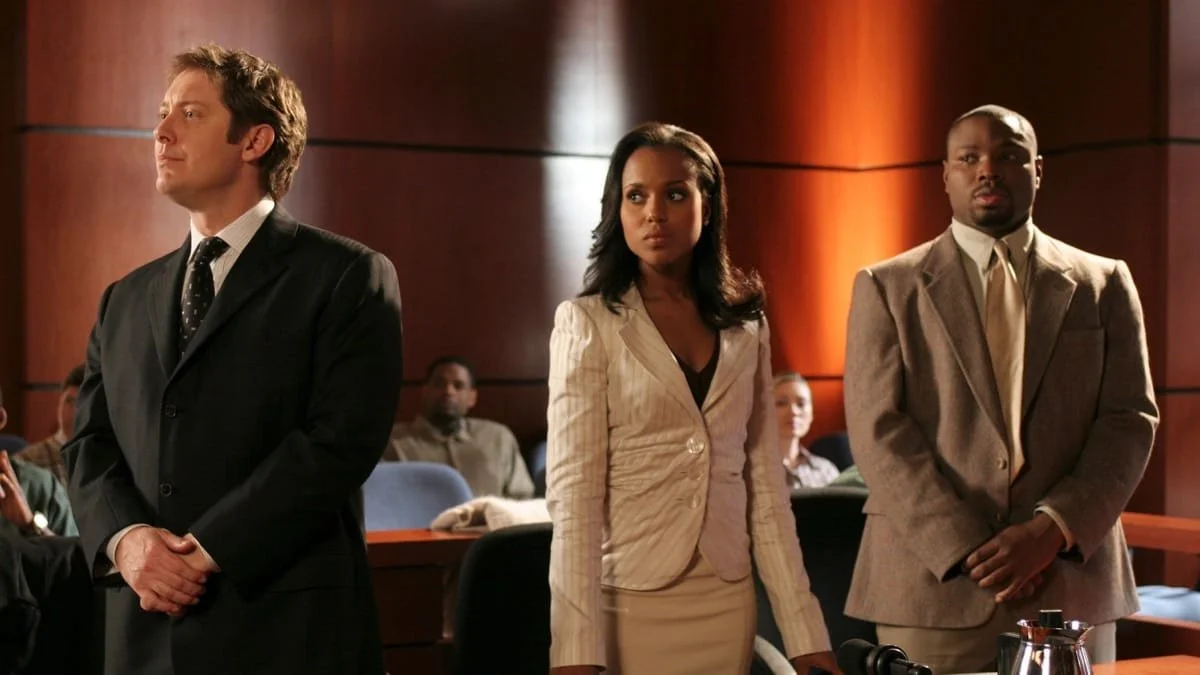
David E. Kelley, Boston Legal’s creator, had a knack for wrapping social critique in wit. “Race Ipsa” balances absurd humor (name partner Denny Crane shooting his therapist in another subplot) with a very real moral outrage. When Alan Shore takes Dennis Pryor’s case, he recruits an old colleague, Chelina Hall (portrayed by Kerry Washington, making a special appearance), to join the defense. Alan breaks the fourth wall with a cynical quip—seeing Chelina again, he hugs her and then marvels, “You look smashing. … And you’re Black!” He practically grins at her confusion. “This is fate,” Alan says, because he “just took a case where I think race was a factor. Profiling. I’d love to exploit you.” Alan’s being cheeky, but the subtext bites: he knows having a Black attorney at counsel table might check the bias slithering under the surface of this trial. Boston Legal always had this layered self-awareness—here it’s using the presence of a Black woman both in-universe (to sway a jury) and outside it (to wink at the audience about tokenism and representation). The show was playing 3D chess with America’s race neuroses, even back then.
In the courtroom scenes, the racial profiling at the heart of the case is laid bare. Under cross-examination, the arresting officer admits point-blank that he stopped Dennis because he was “Black in an all-white neighborhood. Yes, it was a factor.” The prosecutor tries to spin it as common sense: the neighborhood was exclusive, the man a stranger; surely the cops were right to be suspicious. In his closing argument, the ADA even trots out that old chestnut: when it comes to terrorism, of course we target people of Islamic or Arab descent—society condones profiling in the name of safety!. I could practically feel my inner lawyer bristle at that—because I’ve heard the same logic peddled in real-life courtrooms and city halls. The message: a little racial profiling is okay if it makes the (white) public feel safe.
Alan Shore’s rebuttal is a thing of beauty and fury. Rewatching it, I got actual chills. He warns the jury that once you take the stigma off profiling—once you say discrimination isn’t an evil but a “tool”—you grease the slope for any group to be next. Today it’s Muslims at the airport, he argues (this in 2006, mind you, not long after 9/11). Tomorrow it’s Black men looking at pretty houses in white suburbs. He invokes the specter we know too well: DWB, “Driving While Black,” that grim punchline describing how “innocent Black motorists are pulled over every day in this country” for no reason but their race. Dennis Pryor wasn’t even driving, Alan points out, but apparently just “looking at houses” while Black is enough to trigger the same bias.
In a climax that’s equal parts courtroom drama and civic sermon, Alan calls Dennis’s act of resistance patriotic. He name-drops Henry David Thoreau, Susan B. Anthony, Martin Luther King Jr.—Americans who taught that civil disobedience against unjust authority is a duty. Remember Dr. King’s dream? Alan reminds the jury, his voice low but carrying: children one day judged not by the color of their skin. My client was judged by the color of his skin, he thunders. That cannot be acceptable to a country that prides itself on human rights. That cannot be acceptable to twelve of you. In that fictional courtroom, justice wins. The jury nullifies the law’s technicalities and acquits Dennis Pryor on all counts. The innocent man goes free; the racist policing is condemned. Cue the swelling music. Cue my conflicted sigh.
Because in 2025, in the world I live and fight in, we don’t always get such satisfying closure. In fact, we rarely do. I paused the episode right after the verdict, savoring the win, and felt a dark irony wash over me. Race Ipsa aired in spring 2006. We’re now nearing 2026. And in the real America outside my window, the highest court in the land just effectively gave its blessing to the very kind of racial profiling Alan Shore put on trial. The TV jury said “not acceptable.” The real Supreme Court said, well, actually… it is acceptable – as long as the targets are Latino and the badge says ICE.
2025: When Fiction Becomes Fact (and Justice Goes Mad Cow)
The disturbing continuity between 2006’s televised story and 2025’s reality is enough to make me check the calendar – or maybe my head. Did we learn nothing in the interlude? We like to tell ourselves that society progresses in a line or an upward arc. Hell, President Obama got elected just two years after Race Ipsa aired, and many premature eulogies were written for racism in America. But history’s not a straight line; it’s a curving, twisting thing. And sometimes, the arc doesn’t bend toward justice at all – it snaps backward.
A few weeks ago, news crossed my desk (and probably got buried under a thousand louder headlines) about a case called Noem v. Vasquez Perdomo. The Supreme Court’s conservative majority quietly issued a shadow-docket ruling that made my blood run cold. The case involves Immigration and Customs Enforcement – our friends at ICE – running wild in Southern California. Back in June 2025, the federal government unleashed ICE and Border Patrol agents in Los Angeles with a quota of 3,000 arrests per day, “legal constraints and public outcry be damned,” as one lawsuit later noted. These agents weren’t surgically targeting specific criminals; they were conducting broad sweeps – staking out parking lots, bus stops, even car washes and grabbing people who “looked” Latino. Seriously. According to court filings, they “relied on perceived race or ethnicity to select who to stop,” doing suspicionless stops, warrantless home raids, you name it. One ICE insider summed up the ethos chillingly: “All that matters is numbers, pure numbers. Quantity over quality.” In other words, drag in as many brown bodies as possible – the Constitution be damned.
Civil rights groups sued (bless them, they always do). A federal district judge issued orders to stop these dragnet raids, recognizing that such tactics flagrantly violate the Fourth Amendment’s core protection against unreasonable searches and seizures. For a brief moment, it seemed like the courts might actually slam the brakes on racial profiling by ICE, reinforcing that yes, even immigrants and Latino residents have constitutional rights. But on September 8, 2025, the Supreme Court stepped in. By a 6–3 vote, they stayed (i.e. froze) the lower court’s injunction, effectively green-lighting ICE’s race-based sweeps while the litigation continues. The Court didn’t issue a full opinion – this was an emergency order in the dead of night – but Justice Kavanaugh penned a brief concurring note to rationalize it. In essence, he suggested the government had a “fair prospect” of proving these aggressive tactics are legal under the Fourth Amendment. And just like that, the constitutional alarm bell that rang in Race Ipsa – “You can’t target a man just for his race!” – was muffled by the real Supreme Court saying “Actually, you can, for now.” An Attorney General involved even exulted that now “ICE can continue carrying out roving patrols in California,” as if this were a victory worth celebrating. Forgive me if I don’t pop champagne.
Think about the message this sends. In 1975, the Supreme Court (in United States v. Brignoni-Ponce) ruled Border Patrol couldn’t stop a car just because the occupants appeared Mexican – that was an obvious constitutional no-no. Fifty years later, in Noem v. Vasquez Perdomo, our highest court basically shrugged and said actually, detaining people solely for “looking Mexican” might be fine, at least for now. The contrast is stunning. It’s as if the arc of history, instead of bending toward justice, got yanked into a U-turn.
ICE, Racial Profiling, and the Illusion of Legal Progress
On a recent episode of Attorneys with Swag (LatinoJustice episode), one of their attorneys, César Ruiz, broke down just how pernicious the Supreme Court’s move in the Perdomo case is. He explained that ICE’s playbook in California essentially lowered the bar for “reasonable suspicion” to near zero. The “four factors” ICE agents purportedly relied on were: “looking Latino, sounding Latino, being where Latinos are, or being where Latinos work.” Let that sink in. By those criteria, simply being Latino in public is enough to justify a stop. A surname, an accent, a face in a majority-Latino neighborhood or standing outside a Latino-owned business – that alone can mark you for questioning, detention, even a fast-track deportation if your papers aren’t in perfect order. As Ruiz put it bluntly on the podcast, thanks to the Supreme Court’s intervention, “they lowered the bar for reasonable suspicion… on a scale we’ve never seen in this country.” Now, “we could all fall within the scope of that” profiling dragnet. In other words, ICE agents have been effectively told race = reasonable suspicion.
One of the podcast hosts summed it up in a way that made me swallow hard: “It’s like racial profiling is legal.” Legal. That phrase reverberates in my head. A practice we spent decades trying to banish through policy reforms, court rulings, consent decrees – poof. The Supreme Court didn’t explicitly declare it constitutional in a reasoned opinion, not yet. But by halting the injunction that was protecting people, they gave de facto permission. They sent a signal: go ahead, use race as a basis to stop and detain. We might clean up the legal details later, but for now, do your thing.
I’m a lawyer by trade and an optimist by necessity – you can’t do civil rights work otherwise – but I’m also a realist. And the reality is ugly: the law continues to fail Latino communities and other marginalized groups when it comes to basic equal protection. Sure, on paper the Fourth Amendment protects “the people” from unreasonable searches and seizures. But if those words aren’t honored on the ground, what are they worth? In Los Angeles this summer, ICE agents were “not honoring people’s Fourth Amendment and Fifth Amendment rights” at all – they were “running into people’s homes… private establishments,” “abductions going on”. Knowing your rights didn’t help when a tactical vest-clad immigration officer decided to ignore them. And if you seek justice after the fact? It’s a long, uphill slog. You can sue for damages, yes – but by then you or your loved ones might be already deported or lost in the labyrinth of detention. Courts have made it notoriously hard to get injunctions to prevent these abuses (shout-out to a Supreme Court case called Lyons that essentially said you can’t stop a chokehold policy unless you can prove you’ll be choked again imminently – a perverse Catch-22). All of which is to say: The law often reacts slower than injustice unfolds. By the time rights are sorted out, lives have been irreparably upended.
This is the harsh truth I’ve learned in the trenches: progress is not a straight line, and what the law gives, the law (or those who interpret it) can take away. We’ve had victories, yes – I’ve stood on courthouse steps after a big win, thinking we changed the world. But by sunset, the NYPD was back to business as usual on my block, profiling the next kid who looked “out of place.” That bitter aftertaste in Alan Shore’s otherwise triumphant closing – that awareness that it shouldn’t take a jury nullification to get basic justice – is magnified a hundredfold in 2025. In Race Ipsa, a TV jury did the right thing in 44 minutes. In real life, the fight spans generations, and sometimes we’re losing ground.
Media’s Prescience, Society’s Complacency
Rewatching “Race Ipsa” now, I can’t decide what I feel more: admiration for how prescient that episode was, or frustration at how impotent such cultural spotlights seem to be in changing things. Television, movies, news exposés – they’ve been sounding alarms about racial profiling and police abuse for decades. This Boston Legal episode wasn’t even the first; I remember Law & Order tackling “driving while Black” storylines in the ’90s, and Star Trek allegorizing bigotry way back in the ’60s. The scriptwriters see the writing on the wall. They hold up a mirror (sometimes a funhouse mirror) to our society’s ills. And audiences nod along, maybe even clap. But then what? Did Boston Legal’s scathing take on profiling help end the practice? Hardly. The show won some Emmys, the world kept spinning, and police departments kept disproportionately stopping Black and brown people. The media can be prophetic – but prophecy is not progress.
Sometimes I wonder if these legal dramas and critical podcasts serve as a pressure valve for the public’s conscience. We watch a fictional bigot cop get his comeuppance, and we feel satisfied, like justice happened somewhere, so all’s well. The outrage dissipates in a comfortable couch cushion. Meanwhile, out in the real streets, a new Dennis Pryor gets handcuffed for loitering while Black, or an ICE agent shoves a Latino grandmother against a wall demanding proof of citizenship. The dissonance is jarring. I’m an investigative sort, so I dig into facts, I read court decisions, I listen to impacted communities. I know these violations are happening in plain sight. Yet so many of us go about our day as if the TV show resolved it, as if it’s all in the past. That’s the danger of public complacency. We assume the arc of the moral universe is automatically bending the right way, when in fact it bends only as far as we push it – and if we stop pushing, it can curl right back around our throats.
I don’t exempt myself from this criticism. Even as a jaded lawyer, I catch myself wanting to believe the comforting narrative. I want to believe that each generation leaves things a little better for the next. But belief doesn’t make it so. The truth is that rights can be eroded in a blink if we’re not vigilant. One Supreme Court order, one election, one bout of national fear (be it terrorists in 2001 or “illegals” in 2025), and suddenly the hard-won lessons of the past are tossed aside like a bad script. The media can warn us – but it’s up to us whether those warnings spur action or just entertain us for an hour before we change the channel.
Vigilance, or Else the Arc Won’t Bend at All
At the end of “Race Ipsa,” after the verdict, Alan Shore and Denny Crane share a cigar and a scotch on their balcony, musing about the day. Denny, reprieved from his own legal pickle, jokes “God bless America” for letting him off the hook despite literally shooting a man (long story). Alan smiles, but he’s reflective. The fictional justice they witnessed was gratifying, yet fragile. He knows it; we know it. That’s why he fought so hard – because the law doesn’t always side with what’s right, and it takes relentless pressure to make it do so even occasionally.
Sitting here now, I feel a similar wary reflection. God bless America, indeed – a country that preaches equality under law yet repeatedly finds loopholes when equality is inconvenient. A country where a TV show in 2006 could foresee the precise civil rights battles we’d be having in 2025, and where that foresight wasn’t enough to prevent those battles from raging anew. It’s not that history flat-out repeats; it’s that it echoes in spirals, and right now those echoes are deafening. Racial profiling was supposed to be a shameful relic we left behind, but the Supreme Court has invited it back in through the front door. Constitutional protections we thought settled – like you can’t be detained just for your ethnicity – are unsettled again. The arc of justice has not just stalled; it’s twisted back on itself.
The kid who got stopped-and-frisked in the Bronx would be furious but not surprised. The public interest lawyer in me is determined not to accept this. And wearing both those hats, I’m here to issue a warning: We cannot be complacent. We cannot assume the media, or the courts, or anyone else will save us if we just sit and watch. The only thing that will stop history from curving backward is us – our vigilance, our voices, our unyielding refusal to let precedent and principle dissolve without one hell of a fight.
Rewatching “Race Ipsa” in 2025, I didn’t just see a TV episode. I saw a mirror and a portent. The message was clear as ever: the thing speaks for itself. Racial injustice, left unchecked, speaks loudly – in police sirens, in slammed doors, in courtroom gavel echoes. It will keep speaking, over and over, until we answer. So let’s answer. Let’s raise our voices and our fists and our voting pens. Let’s demand that our laws live up to our ideals, that our courts remember the Constitution applies to all, and that our society stops treating civil rights as a luxury. The fictional attorneys of Crane, Poole & Schmidt fought the good fight in Boston; the real ones among us must fight it now in America coast to coast. Because if we don’t, the next time I rewatch “Race Ipsa” another twenty years from now, I fear I’ll be writing an even darker post, lamenting how the arc of history never just failed to bend toward justice – it broke entirely.
We must remain vigilant—or else that arc won’t bend toward justice at all. The choice, as always, is ours.
